News
Latest News
Meet our 2026 master’s students
We’re delighted to welcome our new master’s students, who have joined the group for their thesis projects in 2026!
Welcome to the group, Irina!
We are pleased to welcome Dr Irina Pi Jaumà, who joined the Müller group on 1 Oct 2026
With a background in biophysics, Irina completed her PhD at the University of Barcelona, where she explored how physical forces and the surrounding cellular environment shape collective cell migration. Her research brought together theoretical modelling and experimental approaches to better understand the dynamics of living tissues.
We wish Irina a great start and are very happy to have her as part of the group!
Giulia defended her PhD thesis
Congratulations to Giulia Ammirati on defending her doctoral thesis, “Mechanobiological Responses in Cellular Systems after Compression”!
Thank you for the delicious Italian food and such a lovely get-together at your apéro! We’re grateful for everything you’ve brought to the group over the years.
Wishing you lots of happiness and success, Giulia!
Han defended her PhD thesis
Warm congratulations to Han Yu on the successful defense of her doctoral thesis, “Multilevel Inhibitory Mechanisms of Disulfiram in Gasdermin-Mediated Cell Death”!
Thank you for treating us to delicious Chinese food at your apéro and making the celebration so much fun with a lively karaoke session!
We are grateful for your valuable contributions to the Müller Group throughout your PhD and wish you all the very best for the next chapter!
Welcome to the group, Kasper!
On 1 September 2026, Dr Kasper Spoelstra joined the Müller group as a postdoctoral researcher.
Kasper completed his PhD at AMOLF Amsterdam & TU Delft, where he used
organoid models and quantitative imaging to study the dynamics of the
intestinal epithelium.
We are delighted to have Kasper with us. Welcome to the group, Kasper!
Farewell to Xiaole
Today, we gathered for Xiaole’s farewell breakfast and enjoyed a delicious selection of Chinese dishes. It was great to spend time together and celebrate her achievements and the time she has shared with our group.
Thank you, Xiaole, for your contributions to the Müller group. We will miss you and wish you lots of happiness and success in your next chapter.
All the very best from the whole group!
A Warm Welcome to Our Visiting Student Researchers
We are delighted to welcome new students who are joining our group for short research stays: Leo, and Shanay!
A new Nature Structural & Molecular Biology study on how membrane lipids shape GPCR–β-arrestin complex assembly
How do membrane lipids regulate GPCR signalling? A new study in Nature Structural & Molecular Biology combines single-molecule force spectroscopy with molecular dynamics simulations. It was led by co-first authors Florian, on whose PhD work in our group this study builds, and Kristyna, a former postdoc in our group. The work reveals how β-arrestin2 engages the β2-adrenergic receptor in distinct steps and identifies PIP2 as a key regulator of complex assembly and stability.
A new Nature Nanotechnology Perspective on advancing mechanobiology
A new Perspective in Nature Nanotechnology, co-authored by Krishna Chaitanya Kasuba, Upnishad Sharma, Valentin Gensbittel and Michele M. Nava from our group, presents a roadmap for advancing mechanobiology across molecular, cellular and tissue scales. It calls for multiscale measurement tools, realistic biological models, integrated datasets and predictive frameworks to deepen our understanding of complex living systems and advance mechanodiagnostics and mechanomedicine.
Lab Retreat 2026 in Orta San Giulio
From May 4–7, 2026, we gathered in Orta San Giulio, Italy, for our lab retreat. The retreat provided a valuable opportunity to share project updates, discuss new ideas, and strengthen collaborations within the lab. We were delighted to welcome Reinhard Fässler, Gregory Giannone, Sebastian Hiller, and Nico Strohmeyer, whose contributions enriched the scientific program. Together with the inspiring setting by Lake Orta, the retreat was both productive and enjoyable.
Tumour-cell viscosity study featured on the cover of Nature Materials
A multidisciplinary study with contributions from our group has been published in Nature Materials and featured on the journal cover. Led by Valentin Gensbittel, first author and postdoctoral researcher in our group, with contributions from Giulia Ammirati, PhD student in our group, the study shows how tumour-cell viscosity influences metastatic spread. The findings highlight the role of biophysical approaches in understanding cancer progression.
New approach for targeted mitochondrial transplantation published in Nature
How can healthy mitochondria be delivered to the cells that need them? A new study in Nature introduces MitoCatch, a platform for targeted mitochondrial delivery. The work shows that transplanted mitochondria can be taken up by recipient cells and support neuronal survival in models of mitochondrial dysfunction. Upnishad Sharma from our group contributed to the study, helping to characterize interactions between donor mitochondria and recipient cells.
Award of the European Biophysics Association Society (EBSA)
We congratulate Daniel Müller on receiving the 2025 Award of the European Biophysics Association (EBSA), sponsored by NanoTemper, for his innovative development of nanoscale biophysical methods and their application in uncovering fundamental biological processes.
Xiaole Wang defended her PhD thesis
Congratulations to Xiaole Wang on defending her doctoral thesis titled “Characterizing the role of extracellular matrix area and compression to early mammalian cell adhesion”! Thank you so much for your Chinese buffet-style apero - what a culinary treat! Once again, the Müller Force crafted an XL-sized hat for Xiaole.
Ilaria Incaviglia defended her PhD thesis
Congratulations to Ilaria Incaviglia on defending her doctoral thesis with the title “Nanotools to Simultaneously Measure Mass and Mechanical Properties of Cellular Systems”. Ilaria was awarded a ginormous Müller Force hat reminiscent of her recent experiments with huge cantilevers able to balance a spheroid. Thank you for inviting us to a culinary trip to Italy at your apero!
Dr. Carson Cole awarded the ETH Postdoctoral Fellowship
Carson Cole, Ph.D., has been awarded the ETH Zürich Postdoctoral Fellowship. He joins Prof. Dr. Daniel J. Müller’s Biophysics group at D-BSSE to develop biomimetic peptide fibrils to study fibrosis. His work aims to understand fibrotic tissue remodeling and enables innovative in vitro models for therapeutic testing. This prestigious fellowship supports independent, high-impact research for postdoctoral scholars seeking faculty positions.
Florian Wilhelm defended his PhD thesis
Congratulations to Florian Wilhelm on the successful defense of his doctoral thesis, “Mechanistic Insights into Arrestin–GPCR Interactions: Roles of Phosphorylation and Membrane Composition”.
Thank you for the lovely apero and great job solving the puzzles hidden on your hat and cloak!
Matilde Lucioli wins BSSE microscopy image contest!
Matilde Lucioli wins BSSE microscopy image contest at the
traditional "SCF & LAF Advent Apéro".
Upnishad Sharma defended his PhD thesis
Congratulations to Upnishad Sharma on defending your doctoral thesis titled “Mechanobiology of αV-class Integrin-Mediated Adhesion Initiation in Fibroblasts”! Thank you for the flavoursome apero and the celebration afterwards. The Müller Force is ever so grateful for your outstanding contributions to our group!
New publication from Krishna in Nature Nanotechnology
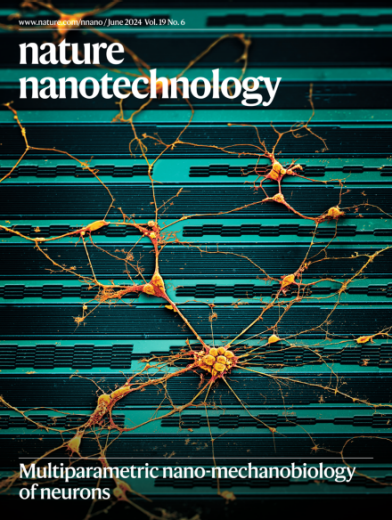
In his latest publication, Krishna characterized how cortical neurons sense and respond to various mechanical stimuli. The cover image of Krishna’s work depicts a colored scanning electron microscopy (SEM) image of a network of cortical neurons grown on a microelectrode array used for combined force and electrophysiological measurements.
In mitosis integrins reduce adhesion to extracellular matrix and strengthen adhesion to adjacent cells
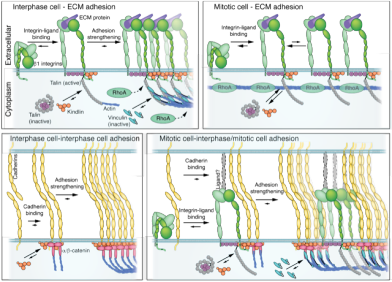
How cells modulate their adhesion to the extracellular matrix (ECM) and to neighboring cells during mitotic cell rounding remained elusive. We recently deciphered that cell-ECM adhesion components are released prior to mitosis and are rewired to synergize with cadherins to strengthen adhesion to adjacent cells.
How cells initially sense and adhere to fibrillar extracellular matrices
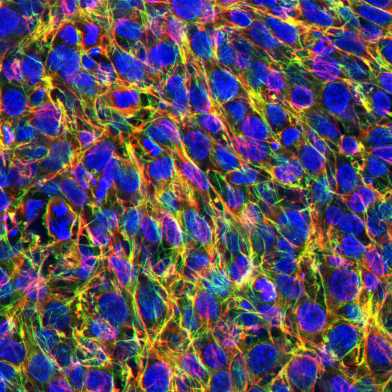
So far, it has remained elusive how cells initially sense and respond to fibrillar extracellular matrices during adhesion initiation and how this initial sensing continuously influences cell behavior. In our recent paper published in Advanced Science, we engineered biomimetic fibrillar fibronectin matrices using 3D-printed microgrids and simple solution shearing.
For more news, see the News Archive page.
Events
1st International Conference Ethics of Engineering Life

The first international conference Ethics of Engineering Life is taking place from 26th to 27th Septemeber 2022 in Rome, Italy.
Participating in the 72nd Locarno Film Festival
Our group enters the world-renowned Locarno Film Festival from August 7–17, 2019. NCCR members Daniel Müller, biologist Barbara Treutlein, and ethicist Ralf Stutzki will discuss "The ethical challenges of engineering life and the effects on human identity". The event will also be broadcast live on the internet and traditionally attracts considerable media attention. Participating in the festival, Selen, from our group will participate in the ‘BaseCamp laboratory of ideas’.
Ethics of Engineering Life Conference
From 16-18 November 2020 our group together with the NCCR Molecular Systems Engineering (www.nccr-mse.org), the pontifical academy of life (PAL) of the Vatican, and the Babino Gesu Children Hospital, organizes an international conference on the engineering of molecular and cellular systems for a better life. Internationally outstanding experts will discuss the topic from scientific, social, historic, ethical, legal and religious perspectives.
ICMSE Conference 2017
From August 27 to 29, 2017 our NCCR Molecular Systems Engineering organizes the first biennial International Conference on Molecular Systems Engineering (ICMSE) in Basel. The ICMSE focuses on the emerging field of molecular systems engineering and will feature speakers and participants from leading international research institutions.